AGILITY

Agility training books - learn how !
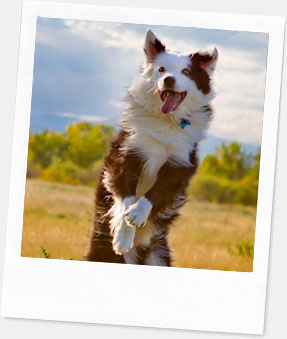
Imagine
your dog sailing over a jump, then
quickly turning and climbing a six-foot A-frame. Slowing for a split
second so that his/her feet touch the yellow contact point at the bottom of
the A-frame, your dog is off, diving into a
tunnel, quickly maneuvering over a twelve-inch wide board that is
positioned four and one-half feet off the ground, jumping through a tire
and weaving at high speed through a line of poles. This is agility, and
it is one of the fastest growing dog sports.
Agility originated in England in 1979 and
is loosely based on the premise of horse jumping. It's a fun, fast-paced
sport that demonstrates teamwork as a handler guides his dog through a
pre-determined course of obstacles. There are several distinct classes
in agility, each with their own set of obstacles, guidelines and goals.
In some classes, the idea is to have the dog complete the course in the
fastest time, without knocking over or refusing any obstacles. In other
classes the obstacles are given point values and the goal then becomes
to accumulate as many points as possible for successfully completing the
most obstacles within the allowed time. A title can be earned in each
class, and in every class you choose to run there is a lot of fun to be
had along the way. Competitors are generally friendly, helpful and offer
encouragement during training and at trials.
TRAINING
CLASSES
In order to begin training your dog, the first step is to find a local
agility club that offers training classes. These clubs usually offer
beginner, intermediate or advanced level classes.
Puppies can start training on the down ramp of an A-frame, learning to
stay on the contact point or perhaps going through tunnels or through tires
that are hung a few inches from ground level. A puppy should not be
asked to jump more than one-foot in height until his/her growth plates
have closed, and because of this you will not be able to enter actual
agility trials until your dog is twelve to eighteen months of age,
depending on the trial and governing organization.
Early training should be a positive, fun experience. Short sessions are
best. Keep the lessons fun and never let your puppy become bored. If you
play games such as ball and tug with your puppy from the time that he/she is
quite small, the two of you will become the best of friends, which will
ease future training. Show your dog that you're excited about agility
and he/she will feel the same. Never exhibit anger when you are training
your dog. Your pet will remember it long past any lesson that he/she may have
learned that day.
One of the most important commands that you can teach your pup before
beginning agility classes is the Come command. Learning to obey this
command is the first step in keeping your pup under control in the
agility ring.
Once the pup is older, your instructor will help you to build on the
basics that you have taught by introducing more challenging
obstacles. Some dogs will learn more quickly than others,
so be patient.
Information
above is used by permission from "Ibizan Hounds, A
Celebration" copyright 2001/02
Photo
of "CZ" Miniature Poodle Owner: Pat
Aloe Stauber
Dog
Agility Organizations:
AKC
www.akc.org
USDAA
www.usdaa.com
NADAC
www.nadac.com